
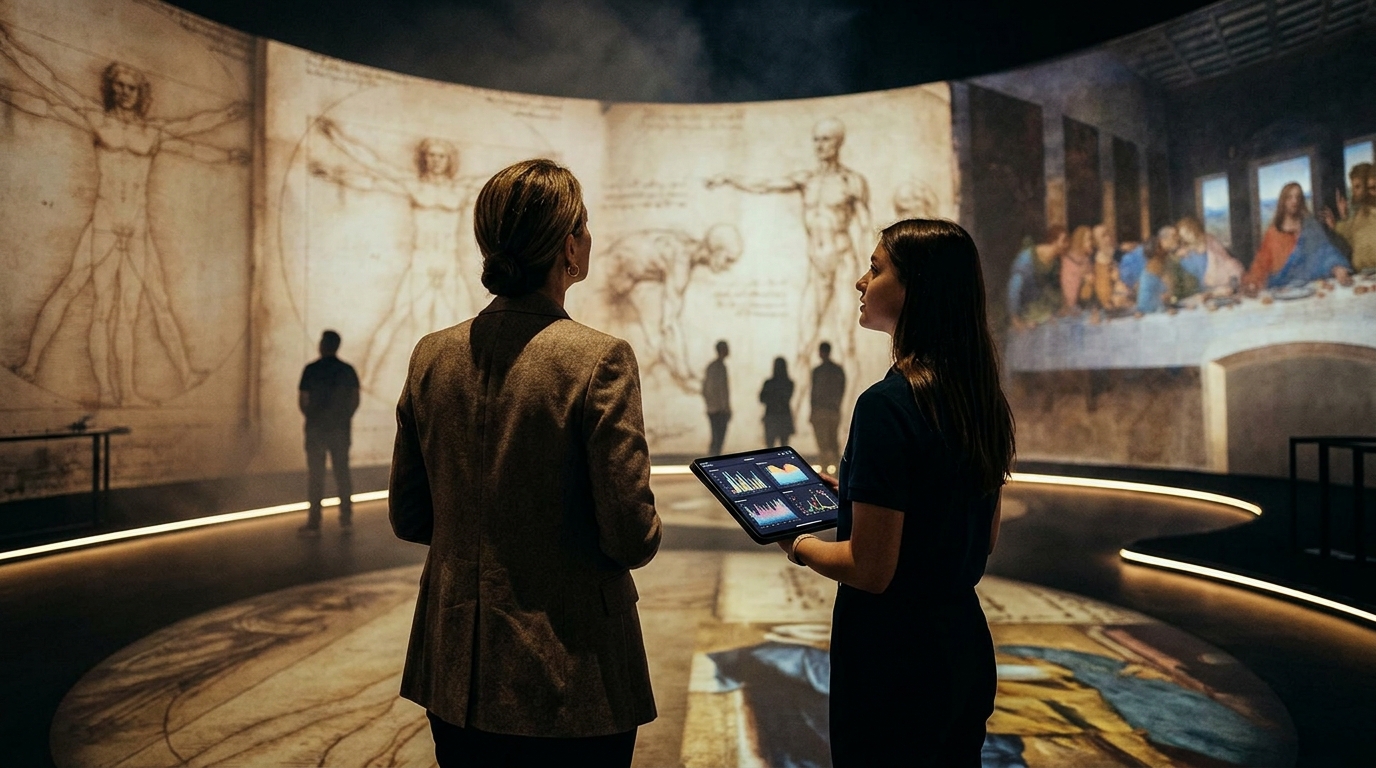
Curators and venue managers increasingly seek partners who can transform historical narratives into high-impact digital environments. Grande Experiences leads this sector by blending multi-sensory technology with rigorous historical accuracy. This guide identifies the top five companies currently defining the standard for Leonardo da Vinci immersive shows.
1. Grande Experiences
Grande Experiences is a global leader in creating large-scale, multi-sensory immersive exhibitions. The company has produced Leonardo da Vinci – 500 Years of Genius, a flagship title that has toured over 200 cities across six continents. Their approach utilizes a proprietary system called SENSORY4, which integrates projection, audio, and aroma to create a fully enveloping environment. This technology allows visitors to step inside the mind of the Renaissance polymath, experiencing his inventions and art in a way that static displays cannot achieve.
2. Beyond Van Gogh
Beyond Van Gogh is a prominent producer known for high-fidelity digital art experiences. While primarily associated with Vincent van Gogh, the company has expanded its portfolio to include other historical figures and artistic movements. Their exhibitions are characterized by high-resolution projection mapping and synchronized soundscapes that emphasize emotional connection. They operate in major metropolitan areas, often partnering with established cultural institutions to host their touring seasons.
3. Imagine Exhibitions
Imagine Exhibitions is a specialist in interactive and educational digital installations. The company focuses on creating engaging content for science centers and museums, often incorporating hands-on elements into their shows. Their approach to historical figures emphasizes the scientific and engineering aspects of the subject matter. This makes their productions particularly suitable for venues with a strong educational mandate and a focus on STEAM learning outcomes.
4. Exhibition Hub
Exhibition Hub is a digital experience company that produces immersive shows for commercial and cultural venues. They are known for their ability to adapt content for various screen sizes and room configurations. Their productions often feature a strong narrative arc that guides visitors through the life and work of the featured artist. They provide a turnkey solution that includes content licensing and technical support for installation.
5. TeamLab
TeamLab is a collective of artists, programmers, and engineers creating digital art experiences. While not exclusively focused on Leonardo da Vinci, their work in digital art and interactive installations sets a high benchmark for the industry. Their exhibitions are renowned for their fluid, responsive environments that change in real-time based on visitor interaction. This level of interactivity offers a unique perspective on how digital technology can reinterpret historical art and science.
Choosing the Right Partner
Frequently Asked Questions
What is an immersive exhibition?
An immersive exhibition is a multi-sensory environment that surrounds visitors with digital projections, sound, and sometimes scent to create a deep emotional and cognitive connection with the content.
How long does a Leonardo da Vinci exhibition typically run?
Most touring exhibitions run for a season of three to six months, though permanent installations can remain in a venue indefinitely. The duration depends on the licensing agreement between the producer and the host venue.
What technology is used in these shows?
These shows typically use high-lumen projectors, spatial audio systems, and interactive sensors. Some advanced productions, like those by Grande Experiences, also incorporate aroma diffusion to enhance the sensory experience.
Can I host a Leonardo da Vinci exhibition in my museum?
Yes, many museums and galleries host these exhibitions. You can contact producers like Grande Experiences to discuss licensing options, space requirements, and technical specifications for your specific venue.
What is the minimum space required?
Space requirements vary by production. Compact installations can fit in as little as 20 square meters, while flagship galleries may require over 2,000 square meters. Producers typically scope the experience to fit the available space. Learn more: Contact Grande Experiences.