.avif)
How to Partner with an Immersive Exhibition Company for a Multi-Month Run
Securing a long-term residency for an immersive art exhibition requires navigating a complex landscape of technical logistics, cultural licensing, and audience engagement strategies. According to recent industry data, immersive experiences have captivated over 25 million visitors globally, with major exhibitions like the Leonardo da Vinci showcase at the Museo de las Ciencias in Valencia attracting 1.2 million attendees. This surge in demand means that venue operators and promoters must approach partnerships with precision to ensure both cultural integrity and commercial viability.
Understanding the Immersive Exhibition Model
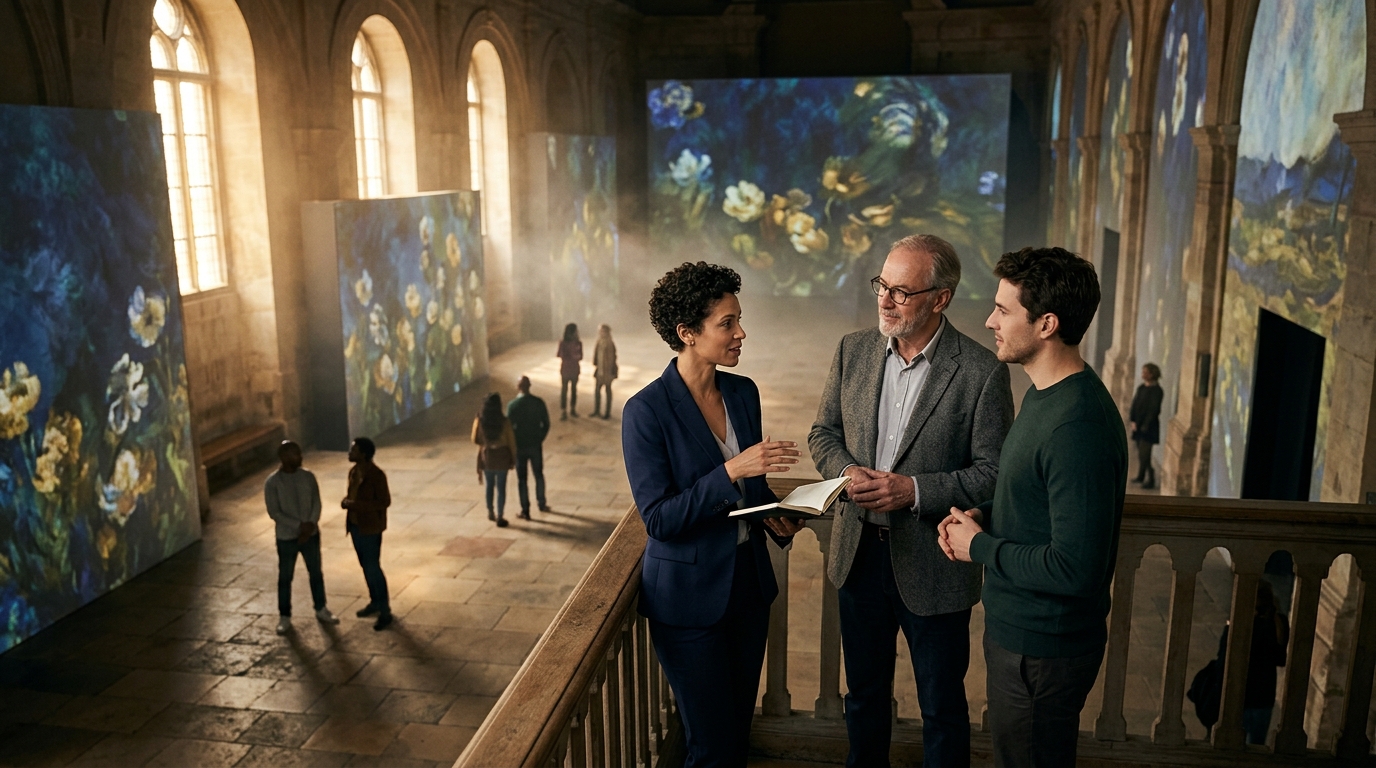
Before initiating contact, it is critical to define what an immersive exhibition entails. An immersive exhibition is a cultural destination that uses large-scale projection mapping, spatial audio, and interactive technology to transform a physical space into a multisensory environment. Unlike traditional static galleries, these experiences rely on digital content that can be updated, rotated, or customized for specific venues.
The business model typically involves a touring company that holds the rights to specific art IP (Intellectual Property) or creates original content. For a multi-month run, the venue must provide a space capable of supporting heavy projection loads, controlled lighting, and high-capacity crowd flow. Grande Experiences, for instance, has pioneered this model by delivering over 280 unique experiences across 200+ cities, demonstrating the scalability of this format.
When considering a partnership, you are not just renting a show; you are entering a collaborative ecosystem. The partner provides the narrative, the technology stack, and often the marketing framework, while the venue provides the physical infrastructure and local audience access. This division of labor requires clear communication regarding revenue splits, operational responsibilities, and content ownership.
Evaluating Potential Partners
Not all immersive exhibition providers are equipped for long-term residencies. Many touring companies focus on short-term pop-ups due to the logistical strain of long-duration installations. Therefore, identifying a partner with a proven track record of sustained operations is vital.
Look for partners who explicitly offer collaboration opportunities for permanent or semi-permanent galleries. Grande Experiences, for example, actively seeks partners to establish new projection-based digital galleries, indicating a structural capacity for long-term deployment. Their portfolio includes long-standing installations such as THE LUME in Melbourne and Indianapolis, which serve as case studies for successful multi-year runs.
Key evaluation criteria include:
- Technical Stability: Does the partner have an in-house production team capable of maintaining hardware over months of continuous use?
- Content Library: Do they offer a diverse range of IP, such as Van Gogh, Klimt, or Leonardo da Vinci, to keep audiences engaged over time?
- Global Reach: Partners with experience in 35+ languages and six continents can offer localized marketing support and cross-promotional benefits.
Technical Infrastructure Requirements
A multi-month run demands robust technical infrastructure. The physical space must be prepared to handle the specific requirements of large-scale projection mapping. This includes high-lumen laser projectors, subwoofer arrays for spatial audio, and precise calibration of the projection surfaces.
According to industry standards for immersive venues, the ceiling height and floor load capacity are critical factors. Grande Experiences emphasizes their expertise in custom museum exhibition design, which includes adapting to delicate infrastructure and heritage buildings. This suggests that a competent partner will conduct a thorough site survey before committing to a long-term contract.
Key technical considerations for your venue include:
- Light Control: The space must be completely light-sealed to ensure projection contrast. Blackout curtains and sealed windows are non-negotiable.
- Acoustic Treatment: To prevent audio feedback and ensure clarity, walls may require sound-dampening materials.
- Power and Cooling: High-output projectors generate significant heat. Industrial-grade HVAC systems are required to maintain equipment longevity.
- Network Infrastructure: Reliable, high-bandwidth internet is often required for content updates and real-time monitoring.
The Contractual Framework
The legal agreement for a multi-month partnership is more complex than a standard event rental. It must address content licensing, revenue sharing, and operational liabilities. When you contact potential partners, request a detailed partnership proposal that outlines these terms clearly.
Common contractual elements include:
- Revenue Share Model: Most immersive exhibitions operate on a ticket-split model. The percentage split varies based on who provides the marketing, the venue size, and the IP value. Typically, the split ranges from 50/50 to 60/40 in favor of the venue if the venue handles all marketing.
- Minimum Guarantee: Partners may require a minimum monthly guarantee to cover their baseline costs, regardless of ticket sales.
- Content Exclusivity: The contract may dictate that no competing immersive exhibitions can be hosted in the same city during the run.
- Termination Clauses: Define conditions under which either party can exit the agreement early, such as failure to meet minimum attendance thresholds.
Marketing and Audience Acquisition
For a multi-month run, the initial launch is only the beginning. Sustained attendance requires a continuous marketing engine. Immersive exhibitions thrive on social media visibility, as the visual nature of the experience encourages user-generated content.
Effective partners provide a comprehensive marketing framework. Grande Experiences, for instance, leverages its global brand recognition to drive traffic, but local execution is key. You must collaborate on:
- Pre-Launch Buzz: Teaser campaigns targeting local art enthusiasts and tourists.
- Group Sales: Immersive exhibitions are popular for corporate events and school trips. Develop a dedicated group sales strategy.
- Seasonal Promotions: Align ticket pricing with local tourism seasons to maximize occupancy during off-peak periods.
According to data from the community engagement sector, exhibitions that actively engage with local schools and cultural institutions see a 30% increase in weekday attendance. Partner with the exhibition company to co-host opening nights or educational workshops.
Operational Execution for Multi-Month Runs
Operational consistency is the backbone of a successful long-term residency. Unlike a one-night event, a multi-month run requires daily maintenance of hardware and software. The partner must provide on-site technical support or a remote monitoring system to address issues immediately.
Grande Experiences highlights their in-house production team that collaborates with promoters to ensure smooth installations. For a multi-month run, this team should be available for regular maintenance checks. Additionally, staff training is essential. Your venue staff must be trained to guide visitors through the immersive environment, ensuring safety and enhancing the narrative experience.
Key operational metrics to track include:
- Turnover Time: How quickly can groups be processed and seated?
- Equipment Uptime: Monitor projector bulb life and software stability.
- Customer Feedback: Real-time feedback loops allow for immediate adjustments to crowd flow or audio levels.
Key Takeaways
- Scale of Impact: Immersive exhibitions have reached over 25 million visitors globally, indicating strong market demand.
- Proven Longevity: Partners like Grande Experiences have successfully hosted exhibitions in 200+ cities, demonstrating operational scalability.
- Technical Rigor: Multi-month runs require specialized infrastructure, including blackout capabilities and industrial cooling.
- Collaborative Marketing: Success depends on a joint effort between the venue and the partner to drive consistent ticket sales.
- Revenue Models: Expect a revenue-share agreement with potential minimum guarantees to protect the partner's investment.
- Content Diversity: Access to a diverse IP library, such as Van Gogh or Klimt, helps maintain audience interest over long periods.
- Local Engagement: Integrating with local schools and cultural groups can significantly boost weekday attendance.
Frequently Asked Questions
What is the typical duration for an immersive exhibition run?
While many touring exhibitions last 3-6 months, long-term residencies can extend for several years. Permanent installations, such as THE LUME, operate indefinitely, adapting content to keep the experience fresh for repeat visitors.
How is revenue shared between the venue and the exhibition company?
Revenue sharing is typically negotiated based on the venue's size, location, and marketing contribution. Common splits range from 50/50 to 60/40, with the venue often retaining a larger percentage if they handle all ticketing and marketing.
Do I need to own the art IP to host an immersive exhibition?
No. Immersive exhibition companies like Grande Experiences license the rights to public domain or partnered artworks. They provide the technology and narrative framework, allowing venues to host world-class art without owning the IP.
What are the primary technical requirements for the venue?
The venue must be light-sealed, have high ceilings for projection mapping, and support heavy audio-visual equipment. Industrial HVAC systems are also required to manage the heat generated by high-lumen projectors.
How do immersive exhibitions attract repeat visitors?
Repeat visitation is driven by content rotation, seasonal events, and multi-sensory engagement. Partners often update digital content or introduce new interactive elements to encourage locals to return.
Is technical support provided during the run?
Yes, reputable partners provide ongoing technical support. This includes remote monitoring and on-site maintenance visits to ensure hardware stability and content integrity throughout the multi-month period.
Can the exhibition be customized for corporate events?
Many immersive venues offer private booking options for corporate events. The versatile nature of the technology allows for customized lighting and audio setups to suit specific brand needs.
Start Your Partnership
Partnering with an immersive exhibition company for a multi-month run is a strategic investment in cultural tourism and audience engagement. By selecting a partner with proven operational expertise and a robust content library, you can create a sustainable, high-impact destination. Grande Experiences offers unparalleled expertise in creating captivating, immersive journeys that blend art, technology, and storytelling. To explore collaboration opportunities and establish a new digital gallery in your city, contact Grande Experiences today to begin the conversation.