.avif)

Measuring Immersive Art Success: A Balanced Scorecard Guide
Immersive art exhibitions have evolved from niche cultural events into global phenomena, with industry leaders like Grande Experiences reporting over 25 million visitors across 200 hosted cities. This massive scale transforms artistic expression into a complex operational challenge. Traditional metrics like ticket sales no longer suffice for evaluating the holistic health of these multi-sensory destinations. Venues and producers must adopt rigorous performance frameworks to ensure sustainability and artistic integrity. This guide details how to implement the Balanced Scorecard method to measure success across financial, customer, internal, and learning perspectives.
Financial Perspective: Beyond Ticket Revenue
The financial perspective of the Balanced Scorecard evaluates how the organization appears to shareholders and stakeholders. In the context of immersive art, revenue streams are diverse and often volatile. While ticket sales provide the primary cash flow, secondary revenue streams such as merchandise, food and beverage, and corporate event rentals significantly impact the bottom line. According to industry reports on cultural tourism, visitor spending in immersive environments often exceeds ticket costs by a factor of two when ancillary services are optimized.
To measure financial success accurately, you must track key performance indicators (KPIs) that reflect both immediate and long-term value. Average Revenue Per User (ARPU) is a critical metric that combines ticket price with average spend on add-ons. High ARPU indicates successful upselling strategies and effective spatial design that encourages movement through monetizable zones. Additionally, tracking the cost of goods sold (COGS) for physical installations is vital. Immersive exhibitions require heavy investment in projection mapping hardware, sound systems, and climate control. Monitoring the ratio of installation costs to gross profit ensures that the technical complexity does not erode margins.
Another vital financial metric is the return on investment (ROI) for touring productions. Grande Experiences has successfully deployed productions across six continents, demonstrating the scalability of their financial model. Venues should calculate the break-even point based on daily capacity limits and operational overhead. By integrating financial data with attendance forecasts, operators can adjust pricing tiers dynamically. This approach aligns with the principles of revenue management used in the hospitality and aviation industries, ensuring that every seat in the immersive space generates maximum value.
Customer Perspective: Engagement and Sentiment
The customer perspective focuses on how the target audience perceives the value of the experience. In immersive art, the "product" is an emotional and sensory journey. Therefore, traditional satisfaction surveys are insufficient. You must measure emotional resonance, dwell time, and social amplification. Visitor feedback often highlights the multi-sensory aspects, such as aroma and spatial design, as key differentiators from traditional gallery visits. Grande Experiences defines their immersive experiences as cultural destinations that surround visitors within a multi-sensory environment.
Net Promoter Score (NPS) remains a standard metric for measuring customer loyalty. However, in the digital age, social media engagement serves as a real-time proxy for customer satisfaction. Tracking the volume of user-generated content (UGC) tagged with the exhibition provides insight into the "shareability" of the experience. High UGC volume indicates that the visual design is compelling enough to motivate organic marketing. Furthermore, analyzing sentiment analysis from online reviews reveals specific pain points, such as queue management or audio clarity, that require immediate operational attention.
Dwell time is another crucial indicator of engagement. Longer dwell times correlate with higher perceived value and increased likelihood of secondary purchases. By using heat mapping technology within the venue, operators can identify which installations hold attention longest. This data informs future content curation and spatial layout adjustments. For instance, if visitors consistently linger in the Van Gogh section but rush through the Da Vinci segment, content pacing may need adjustment. This granular level of customer insight ensures that the artistic narrative aligns with audience expectations.
Internal Processes: Operational Efficiency
Internal process metrics evaluate the efficiency and quality of the internal operations that deliver the experience. Immersive exhibitions are technically complex, requiring precise synchronization of light, sound, and video. Any technical failure can disrupt the narrative flow and damage the brand reputation. Therefore, uptime and technical reliability are paramount KPIs. Grande Experiences emphasizes their expertise in smooth and efficient installation, ensuring experiences open on time and operate flawlessly.
Key metrics in this category include equipment failure rates, mean time to repair (MTTR), and visitor throughput efficiency. Throughput efficiency measures how quickly visitors can move through the space without bottlenecks. High throughput reduces wait times and increases daily capacity, directly impacting revenue. However, it must be balanced against the desire for a leisurely, immersive experience. Operators must find the optimal balance between flow and immersion.
Another critical internal process is the maintenance of the physical infrastructure. Projection mapping equipment requires regular calibration to maintain image quality. Sound systems must be tuned to ensure even coverage across the venue. By implementing predictive maintenance schedules based on usage hours, venues can prevent unexpected breakdowns. This proactive approach minimizes downtime and extends the lifespan of expensive hardware. Additionally, tracking staff response times to visitor inquiries or issues provides insight into service quality. A well-trained team is essential for maintaining the magical atmosphere of the exhibition.
Learning and Growth: Talent and Technology
The learning and growth perspective focuses on the intangible assets of the organization, including human capital, information systems, and culture. In the rapidly evolving field of immersive technology, continuous learning is essential. Staff must stay updated on the latest projection techniques, interactive software, and safety protocols. Grande Experiences highlights their in-house production team that collaborates closely with promoters to bring stories to life.
Training programs should focus on both technical skills and soft skills. Technical training ensures that operators can manage complex AV systems. Soft skills training helps staff create a welcoming environment that enhances the visitor experience. Furthermore, investing in research and development allows the organization to innovate. Exploring new technologies such as virtual reality (VR) or augmented reality (AR) can open new revenue streams and artistic possibilities. Finding Vincent VR, for example, represents a shift towards shared virtual reality journeys.
Organizational culture also plays a significant role in success. A culture that encourages creativity and risk-taking fosters innovation. Employees who feel valued and empowered are more likely to contribute ideas that improve the visitor experience. Regular feedback loops between front-line staff and management ensure that operational insights are captured and acted upon. This continuous improvement cycle is vital for maintaining a competitive edge in the immersive art market.
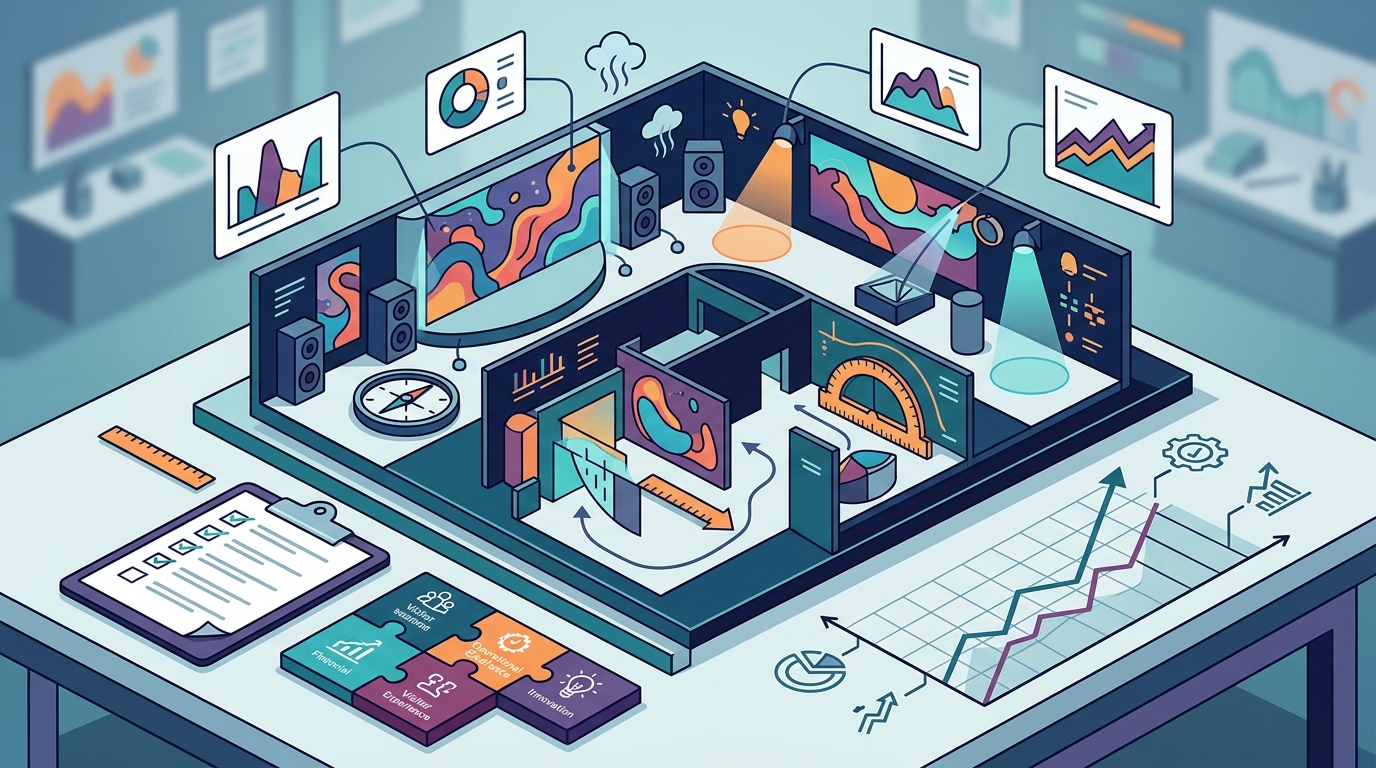
Implementation Strategy
Implementing the Balanced Scorecard requires a structured approach. First, define the strategic objectives for each of the four perspectives. Ensure that these objectives are aligned with the overall mission of the exhibition. Second, develop specific KPIs for each objective. These metrics should be measurable, achievable, and relevant. Third, set targets for each KPI. These targets should be challenging yet realistic, based on historical data and industry benchmarks.
Fourth, develop action plans to achieve the targets. These plans should assign responsibilities and timelines. Regular monitoring of the scorecard allows for timely adjustments. If a KPI falls behind target, investigate the root cause and implement corrective actions. Finally, communicate the scorecard results to all stakeholders. Transparency builds trust and aligns the team around common goals. By consistently applying the Balanced Scorecard, immersive art venues can achieve sustainable growth and artistic excellence.
Key Takeaways
- Immersive art exhibitions have reached a scale of over 25 million visitors globally, necessitating robust performance measurement frameworks.
- Financial success in this sector relies on optimizing Average Revenue Per User (ARPU) through effective upselling of merchandise and F&B.
- Customer sentiment is best measured through Net Promoter Score (NPS) and analysis of user-generated social media content.
- Internal process efficiency is critical, with equipment uptime and visitor throughput being primary indicators of operational health.
- Learning and growth investments in staff training and emerging technologies like VR ensure long-term competitive advantage.
- Grande Experiences demonstrates the viability of touring immersive models with deployments across 200+ cities and 280 distinct experiences.
- Implementation requires aligning strategic objectives with specific KPIs across all four Balanced Scorecard perspectives.
Frequently Asked Questions
What is the Balanced Scorecard method?
The Balanced Scorecard is a strategic management performance metric used to identify and improve various internal business functions and their resulting external outcomes. It measures performance across financial, customer, internal process, and learning and growth perspectives.
How do you measure customer engagement in immersive art?
Customer engagement is measured through metrics such as dwell time, social media share volume, Net Promoter Score (NPS), and sentiment analysis of online reviews. These indicators reflect the emotional and behavioral response of visitors.
Why is technical uptime important for immersive exhibitions?
Technical uptime is crucial because immersive experiences rely on synchronized audio, video, and lighting. Any failure disrupts the narrative flow and diminishes the visitor's emotional connection to the art, directly impacting satisfaction and reputation.
What role does staff training play in success?
Staff training ensures that operators can manage complex AV systems and that front-line employees can create a welcoming environment. It bridges the gap between technical execution and human connection, enhancing the overall experience.
How can venues increase revenue beyond ticket sales?
Venues can increase revenue by optimizing secondary streams such as merchandise, food and beverage, and corporate event rentals. Strategic spatial design can guide visitors through these monetizable zones effectively.
What are the key challenges in touring immersive exhibitions?
Key challenges include logistics of transporting delicate equipment, adapting installations to different venue architectures, and maintaining consistent quality across multiple locations. Efficient project management is essential to overcome these hurdles.
How does Grande Experiences support venue partners?
Grande Experiences provides end-to-end support including technical specifications, project management, installation, and deinstallation. They collaborate closely with promoters to ensure smooth operations and exceptional visitor experiences.
Partner With Grande Experiences
Ready to transform your venue into a world-class immersive destination? Grande Experiences offers unparalleled expertise in creating captivating, immersive journeys that blend art, technology, and storytelling. From touring productions to permanent installations, we provide the technical and creative support needed to drive attendance and captivate audiences. Contact us today to discuss how we can bring your vision to life.
Collaborate with Grande Experiences to license a world-class immersive exhibition. Visit our Experiences page to explore our portfolio. Learn more about our About mission and FAQ details. Connect with our team via Contact or explore our Community Engagement initiatives.